Asiáticos
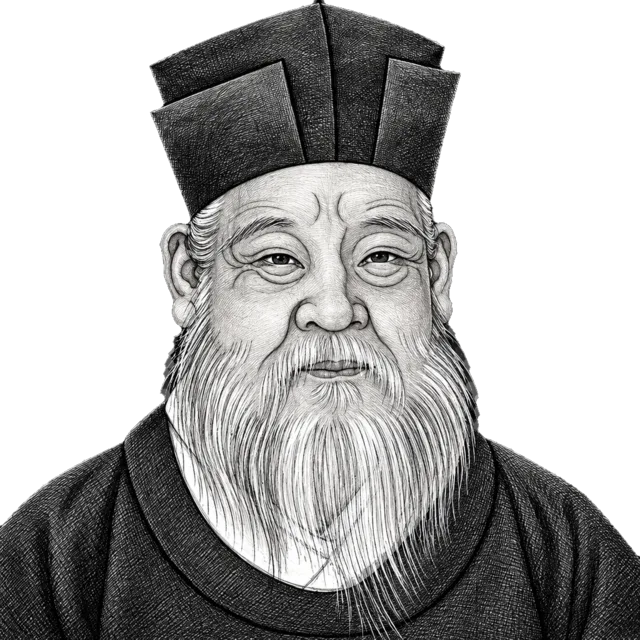
Zhu Xi
Maestro Zhu
octubre de 1130 d. C. – 1200 d. C. · fl. segunda mitad del siglo XII · Fujian (nacimiento; localidad con grafía discutida)
Neoconfucianismo Song; tradición Cheng-Zhu
En el debate
Zhu articula investigación y cultivo, comprensión y acción, y reflexión sobre la lectura. Cuestiona la ostentación y la práctica separada del discernimiento, sin volver absolutos los contrastes entre actividad y quietud o entre exámenes y aprendizaje.
Estilo de discurso
Las conversaciones presentan preguntas, objeciones y respuestas, analogías concretas y exhortaciones al esfuerzo. Zhu incorpora dichos y textos ajenos, y contrasta sus sentidos dentro de cada contexto.
Tesis centrales
- Nutrirse e investigar el principio son procesos inseparables: cada uno se realiza dentro del otro.
- La comprensión del texto exige familiaridad y reflexión, y debe seguir abierta a nuevas preguntas incluso después de alcanzar claridad.
- Aprender para uno mismo busca una comprensión que transforme al estudiante, en lugar de hacer ostentación de lo entendido ante otros.
- El significado de los términos debe leerse en el contexto de cada texto, sin fijarse en un carácter aislado ni imponer equivalencias idénticas entre obras.
- Preservar la mente e investigar el principio se implican mutuamente: ninguno alcanza su realización separado del otro.
- En el intercambio con Wang Tzu-ch’ung, Zhu cuestiona actuar sin claridad sobre el principio moral y vincula esa claridad con relaciones humanas concretas.
- Actividad y quietud no se excluyen absolutamente en la vida mental: hay actividad en la quietud y quietud en la actividad.
- En 7.62, Zhu cuestiona la falta de determinación cuando se invocan la familia o la preparación de exámenes para abandonar el aprendizaje propio.
Conceptos clave
principio moralinvestigación y cultivomente y principioaprendizaje para uno mismofamiliaridad y reflexiónpregunta continuadacontexto interpretativoactividad y quietuddeterminaciónexámenes y aprendizajevoces citadas y mediación del traductor
Obras principales
- Reflections on Things at Hand (Jinsilu)
- Sishu zhangju jizhu 四書章句集註 (Daxue, Zhongyong zhangju; Lunyu, Mengzi jizhu)
- Huian xiansheng Zhu Wengong wenji 晦庵先生朱文公文集 (Collected Works), Sibu congkan edition
- Renshuo 仁說 (A Treatise on Humanity)
- Learning to Be a Sage — translated learning selection
Citas emblemáticas
The effort to probe principle is naturally subsumed in the nurturing process—one probes the principle being nurtured. The effort to nurture is naturally subsumed in the process of probing principle—one nurtures the principle being probed. These two processes are inseparable. As soon as one sees them as two different endeavors, nothing will be achieved. — Investigar el principio y nutrirse se incluyen mutuamente: se investiga el principio que se nutre y se nutre el que se investiga. El diálogo los declara inseparables y advierte contra tratarlos como dos empresas independientes. (Learning to Be a Sage — translated learning selection, Gardner learning selections)
Generally speaking, in reading, we must first become intimately familiar with the text so that its words seem to come from our own mouths. We should then continue to reflect on it so that its ideas seem to come from our own minds. Only then can there be real understanding. Still, once our intimate reading of it and careful reflection on it have led to a clear understanding of it, we must continue to question. Then there might be additional progress. If we cease questioning, in the end there'll be no additional progress. — Primero debe alcanzarse familiaridad con las palabras, después reflexionar hasta comprender sus ideas como propias. Incluso cuando lectura y reflexión producen claridad, deben continuar las preguntas: detenerlas impide un progreso adicional. (Learning to Be a Sage — translated learning selection, Gardner learning selections)
The important thing for students today is to distinguish between the paths. What's important is the boundary between ‘doing it for one's own sake’ and ‘doing it for the sake of others.’ ‘To do it for one's own sake’ is to grasp the essence of things and affairs firsthand in reaching an understanding of them—you want to understand them for yourself. It isn't to understand them recklessly, nor is it to understand them in a way that makes you look good, so that people will say yes, you have indeed understood; if this is how you were to go about it, even supposing you did understand them 100 per cent accurately, they'd still have no effect on you at all. You must first come to understand these paths: for only if you distinguish clearly between them can you understand the texts. — El pasaje distingue aprender para uno mismo y aprender para que otros lo vean. Lo primero busca comprender de primera mano; lo segundo puede producir incluso un entendimiento enteramente correcto sin transformar al estudiante. Deben distinguirse esos caminos para entender los textos; la distinción citada remite a Confucio en la nota editorial37. (Learning to Be a Sage — translated learning selection, Gardner learning selections)
Generally, in reading, we must look at the meaning of the surrounding text. We mustn't fixate on the individual character alone. For example, the Model Sayings of Master Yang [Yang-tzu fa-yen] [says]: ‘in being jen [benevolent] he is yielding, in being i [righteous] he is unyielding’; but in the Book of Changes, unyielding is equated with jen and yielding with i. For another example, in the Analects ‘to learn without flagging’ is chih [knowledge] and ‘to teach without growing weary’ is jen [benevolence]; but in the Doctrine of the Mean it's said that ‘to bring completion to oneself’ is jen and ‘to bring completion to things’ is chih. In these instances it is essential that we read according to the sense of the original text itself, then there'll be no problems. — Debe atenderse al texto circundante y no al carácter aislado. El diálogo contrasta los usos de jen e i en las Sentencias del maestro Yang y en el Libro de los Cambios, y los de jen y chih en las Analectas y en la Doctrina del Medio. Cada contraste conserva su voz y su contexto; los corchetes explicativos son del traductor, y no se impone una equivalencia uniforme. (Learning to Be a Sage — translated learning selection, Gardner learning selections)
The mind embraces the myriad manifestations of principle. The myriad manifestations of principle are embodied in the one mind. Unable to preserve the mind, one is unable to probe principle. Unable to probe principle, one is unable to give full realization to the mind. — La mente abarca las múltiples manifestaciones del principio y estas se encarnan en la mente. Sin preservarla no puede investigarse el principio; sin investigarlo no puede realizarse plenamente la mente. (Learning to Be a Sage — translated learning selection, Gardner learning selections)
Wang Tzu-ch'ung inquired: When I was in Hunan, I visited a master who instructed people simply to act. Master Chu said: If moral principle isn't clear, how can one act? Wang said: He said that if you act, you will then understand. Chu replied: This is like someone walking along a road. If he doesn't see, how can he walk? Nowadays people often instruct others to act—they establish this standard for themselves, then teach it to others. Of course, there is the type of person whose natural disposition is good and doesn't need to probe principle, apprehend the principle in things, or extend knowledge. But the Sage wrote the Greater Learning so that all men could enter the realm of sages and worthies. Once men understand moral principle clearly, naturally they cannot but be filial in serving their parents, fraternal in serving their brothers, faithful in intercourse with their friends. — Wang Tzu-ch’ung relata que otro maestro enseñaba a actuar sin más. Zhu pregunta cómo actuar sin claridad acerca del principio, comparándolo con caminar sin ver. Admite el caso excepcional de una disposición naturalmente buena, pero presenta la Gran Enseñanza como vía abierta a todos: comprender el principio debe manifestarse en piedad filial, fraternidad y fidelidad entre amigos. El informe de Wang y las respuestas de Zhu no son la misma voz. (Learning to Be a Sage — translated learning selection, Gardner learning selections)
There's activity in quiescence, as when an idea arises in the mind. And there's quiescence in activity. Each one entrusts itself to the other. — Hay actividad en la quietud, como al surgir una idea, y quietud en la actividad; cada una se confía a la otra. La relación no se presenta como una separación absoluta de dos estados mentales. (Learning to Be a Sage — translated learning selection, Gardner learning selections)
If you believe that the civil service examinations are for your family's sake and therefore don't engage in learning for your own sake, it's simply that you lack the determination. And if you believe preparing for the examinations interferes with true learning—I don't know that it interferes with your eating and drinking—it's simply that you lack the determination. — Si se invocan los exámenes como deber familiar para abandonar el aprendizaje propio, el pasaje lo atribuye a falta de determinación. Si se cree que prepararlos interfiere necesariamente con aprender, vuelve a cuestionar esa determinación y conserva la comparación con comer y beber. Deben retenerse ambas condiciones y el contexto de 7.61, que permite preparar los exámenes; no es un rechazo general del examen. (Learning to Be a Sage — translated learning selection, Gardner learning selections)
If you practice quiet-sitting for a long time, you'll become muddled and weary, incapable of thinking. When you get up, you'll feel agitated and won't think calmly. — La advertencia se refiere a practicar quiet-sitting durante mucho tiempo: produciría confusión, cansancio y luego agitación, sin pensamiento calmado. No se elimina la condición temporal. Gardner, en su nota 40, reconoce un papel para esa práctica, advierte contra exagerarla y remite a6.61; ese contexto es editorial, no una frase adicional de Zhu. (Learning to Be a Sage — translated learning selection, Gardner learning selections)
Formerly, Mr. Ch'en Li was distressed that he had no [power of] memory. One day he read the Book of Mencius: ‘The great end of learning is nothing else but to seek for the lost mind.’ Suddenly, he was enlightened and said: ‘If my mind is not retrieved, how will I be able to remember a book?’ Thereupon he shut his door and engaged in quiet-sitting; for more than a hundred days he didn't look at a book and thereby retrieved his lost mind. He then went to read, and with one glance he absorbed everything. — Se narra que Ch’en Li, preocupado por su memoria, leyó en Mencio que aprender consiste en buscar la mente perdida. Ch’en Li interpreta que debe recuperarla, se retira y practica quiet-sitting durante más de cien días antes de volver a leer. Se preservan Mencio, el discurso de Ch’en Li y el narrador como voces distintas. El añadido [power of] es de Gardner; la anécdota no prescribe esa duración a todo estudiante. (Learning to Be a Sage — translated learning selection, Gardner learning selections)
In reading a text, you must be full of vigor. Arouse your spirits, keep your body alert, and don't let yourself grow weary—as if a sword were at your back. You must pierce through each passage. ‘Strike the head, the tail responds; strike the tail, the head responds.’ Only then have you read it right. You cannot open a book and fix your mind on it then close it and forget about it. Nor can you when reading the commentary forget about the text or when reading the text forget about the commentary. You must pierce through one passage and only then go on to later ones. — Leer exige vigor, atención corporal y mental y penetrar cada pasaje antes de avanzar. El texto y su comentario no deben olvidarse mutuamente. La imagen de golpear cabeza y cola es una cita incorporada: Gardner señala en la nota 4 una procedencia modificada de Sun-tzu, por lo que no se atribuye exclusivamente a Zhu. Se conserva el pasaje completo, incluidas esas relaciones. (Learning to Be a Sage — translated learning selection, Gardner learning selections)
Now if you can't see moral principle clearly, it isn't that you don't know what it is but rather that it is obstructed by things. Now the ordinary means [of dealing with this problem] is to rectify the many evil distractions in the mind. Only then can [moral principle be seen]. Master Chang said: ‘If moral principle is obstructed, wash away your old understanding and bring forth new ideas.’ The big problem is that men frequently are unwilling to give up their old understanding. If intelligent, they will see what isn't right and change it. — La falta de claridad se explica por obstáculos y distracciones de la mente. El pasaje incorpora una declaración del maestro Chang sobre lavar el entendimiento anterior y suscitar ideas nuevas; después vuelve a la resistencia de los hombres a abandonar sus opiniones. La cita de Chang y las aclaraciones entre corchetes del traductor permanecen diferenciadas del resto del diálogo. (Learning to Be a Sage — translated learning selection, Gardner learning selections)
Before encountering some affair, the mind must be quiescent. Only when the affair's at hand should it be employed, then it'll have the strength to respond. If it isn't quiescent when it ought to be, its thoughts will become confused, and when the affair's at hand it'll already be weary. The passage in which I-ch'uan explains quiescence as concentration [goes on to] say: ‘If [in quiescence] it doesn't concentrate, [in activity] it'll be unable to follow the right.’ At rest gather it in; then in doing things, you'll have the mental energy. — La mente debe recogerse antes del asunto para responder con energía cuando llegue; la confusión anticipada la agota. El diálogo incorpora y comenta un pasaje de I-ch’uan sobre concentración en quietud y acción. Los corchetes del texto pertenecen a la mediación editorial; no se funden las voces en una única afirmación sin atribución. (Learning to Be a Sage — translated learning selection, Gardner learning selections)
Learning must genuinely be for the sake of oneself; if it is, one will become tranquil and true and embody the many manifestations of moral principle. If a person touches only slightly on learning, how will he get at moral principle? And even if he does get at it and talk about it, he still won't embody it. — Aprender para uno mismo debe conducir a tranquilidad, autenticidad y encarnación del principio moral. Acercarse apenas al estudio no basta; incluso hablar del principio sin llegar a encarnarlo no cumple esa exigencia. (Learning to Be a Sage — translated learning selection, Gardner learning selections)
Relaciones
Maestros
- Li Tong
Fuentes del dossier
Fiabilidad biográfica: alta
- Stanford Encyclopedia of Philosophy, «Zhu Xi», referencia secundaria almacenada por el pipeline, 1. Life and Works; fecha y hash del caché conservados
- Internet Encyclopedia of Philosophy, «Zhu Xi (Chu Hsi, 1130–1200)», referencia secundaria del caché, Encabezamiento y 1. Life and Work
- Reflections on Things at Hand (Jinsilu), compilación de Zhu Xi y Lü Zuqian, traducción y notas de Wing-tsit Chan (1967), Información editorial de la antología; no se asigna en bloque su autoría a Zhu Xi
- Learning to Be a Sage — translated learning selection, Daniel K. Gardner (1990), traducción y comentario, Selección 1.1–7.69, PDF 102–210; citas y extractos restringidos a pasajes completos de la lista revisada